Ulithi Atoll
The Caine MutinyUlithi Atoll is a Pacific island anchorage that becomes a staging ground for the novel’s fleet operations and a defining setting for the worn-out USS Caine. The ship arrives to tow gunnery targets, shares the lagoon with a vast concentration of warships, and returns there after a typhoon has battered it. Against Ulithi’s sheltered waters and immense fleet, the Caine’s small size and precarious condition make the difference between naval power and individual vulnerability visible.
Setting and Strategic Position
Ulithi is described as a ragged ring of islands, reefs, and green water, situated halfway between Guam and the newly captured Palaus. The Caine enters through a gap in the reef’s breakers and proceeds into the central anchoring area. The lagoon is not merely a remote backdrop: its protected anchorage holds ships arriving from different directions and allows the fleet to gather for later operations.
The novel identifies Ulithi as the place where the Navy has assembled its main striking power for the assault on Luzon. Battleships and carriers fill the lagoon, their scale set against a delicate ring of palms. The atoll’s isolation and limited physical extent make the concentration seem almost improbable: a small coral enclosure in a vast ocean becomes the meeting point for a force whose size appears to embody the power of the war.
The Caine’s Arrival and Target-Towing
On October 1, while Philip Francis Queeg remains in command, the old minesweeper enters Ulithi and maneuvers toward its assigned anchoring berth. Willie Keith is on the starboard wing when Tom Keefer draws his attention to an LST about a thousand yards away. Three sixty-ton target sleds are tied to the landing ship’s open bow ramp. The sight explains the Caine’s otherwise puzzling high-speed dispatch from Eniwetok to Ulithi: it has been sent to tow targets for fleet gunnery practice.
The work quickly establishes the ship’s daily relation to the lagoon. The Caine leaves the channel with a target at dawn, spends the day towing it in open water, and usually returns to anchor at dusk. The routine is monotonous, but it has a marked effect on Queeg. During the first days he becomes even more irritable; afterward he falls into a withdrawn, nearly comatose state and turns the ship’s conning over to Steve Maryk, including the morning departure and evening return. In fog or rain Queeg sometimes comes to the bridge and takes the conn himself. Ulithi thus becomes the setting for a consequential shift in the ship’s everyday command, produced amid repetitive work rather than a battle.
The anchorage also connects the Caine’s officers with a wider fleet community. One evening, as the ship returns at sunset and drops anchor, it receives a blinker message from the carrier Montauk. Roland Keefer identifies himself and invites the Caine’s officers to visit. Tom Keefer is surprised to learn that his brother is aboard the carrier; he had last heard of Roland months earlier and had received no letters from him. The brief exchange makes the crowded lagoon a place not only of operational assignments but also of unexpected personal news.
A Fleet Anchorage After the Typhoon
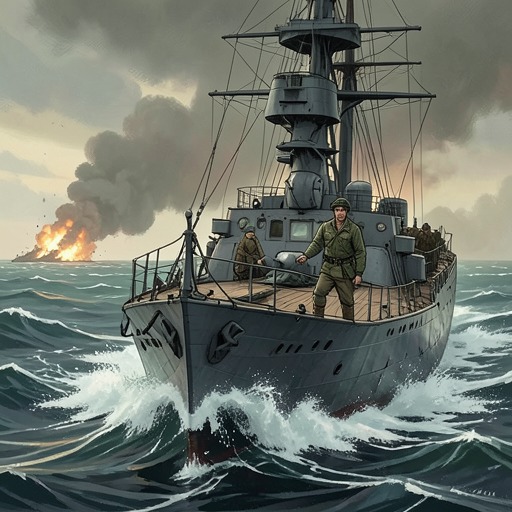
On a later return to Ulithi, the Caine is part of a group of ships that has come out of Apra Harbor. The typhoon has passed about 150 miles to the north, and the ships separate, with one group returning to Guam and the other proceeding to Ulithi. The Caine travels with the Ulithi-bound group. Although it has not passed through the storm’s center, the backwash has battered the minesweeper: stores have been thrown about, water has entered the passageways, the rusty hull has sprung leaks, and antennas, a davit, and depth-charge racks have been damaged. The crew has gone without hot food and has had little sleep.
This damaged arrival changes the crew’s familiar view of the atoll. They ordinarily speak of Ulithi dismissively, but after the rough passage its sunny lagoon seems like a welcome refuge. The contrast belongs to the ship’s daily experience of war: the same anchorage can feel remote and tiresome during routine service, then restorative after a punishing voyage. Ulithi does not erase the Caine’s damage; it provides a place where the ship and crew can arrive amid the gathered fleet.
Scale, Vulnerability, and the Novel’s Account
Willie Keith spends hours on the Caine’s forecastle looking at the battleships and carriers assembled in the lagoon. Their presence recalls his earlier peacetime belief that warships were only large toys. Experience has altered that judgment: he has seen such ships take part in struggles over life, death, freedom, and slavery, and now regards them with awe. Yet the scene also corrects that reverence. Ulithi is only a small coral enclosure in an immense ocean, and even the entire Third Fleet sinking there would scarcely change the sea’s level. A typhoon, despite being only one storm in one part of that ocean, can still exceed the capacity of the ships gathered against it.
The atoll therefore holds two scales in view at once. Its lagoon concentrates the machinery of a major campaign, while the Caine’s target-towing and storm-damaged return keep attention on the routine labor and material limits beneath that spectacle. Ulithi’s narrative importance comes from this conjunction: it is an operational gathering place, a temporary haven for a battered ship, and a vantage point from which the fleet’s grandeur is measured against the ocean’s greater reach.
The setting belongs to a fictional account of the Second World War, not a documentary record of a real ship’s service at Ulithi. The author’s note states that the people and events aboard the Caine are imaginary and that times, places, ship missions, and naval procedures have been altered. Accordingly, the novel’s Ulithi is best understood as the historical setting for its invented naval story, rather than as a precise account of actual operations at the atoll.